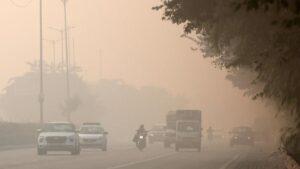




Thank you babaji, New Delhi-fication of Mumbai hone se bacha liya aapne.
The air quality in Mumbai has improved drastically and shown a rapid change in appearance this week after months of choking smog and increased pollution. (Bolte hue accha toh nahi lag raha, but Delhi could never).
The Air Quality Index (AQI) of the city and its various monitoring locations had reduced considerably, with the residents waking up to sunnier skies, improved visibility and, not to mention, cleaner air. Social media feeds full of photos of blue skies and clear skylines, and heralded relief and vague optimism to the Mumbaikars.
The recovery was as a result of a mix between the increased vigor in fighting dust pollution and favourable weather that contributed to the dispersal of the built up contaminants.
AQI Drops to a level of ‘Good’
In some sections of Mumbai, the air quality had until recently registered above 300, which qualifies the quality of the air as very poor and severe. This week readings fell down to the 60-80 scale in most of the areas with some pockets of readings reportedly at around 50. Even in cleaner parts of South Mumbai, the level of the AQI dropped to as low as below 50 and, in some cases, it was close to 30.
According to data provided in the SAMEER app of the Centre, the overall AQI of the city on Friday morning was approximately 50, which is in the category of good. This was a significant departure of the gagan-choomte levels which had taken over headlines in the recent months.
Nevertheless, the quality of air was different in neighbourhoods. Bandra-Kurla Complex registered an AQI of 58, Andheri East 76 and Deonar 73. Kandivali had a population of 65, Malad had 47 and Mulund West had 25. There was relatively cleaner air in South Mumbai where Worli was 56, Colaba was 57 and Byculla was 41. All these differences help to highlight the microclimatic and urban density disparities of the city, whose traffic density, the intensity of industrial operations, and the intensity of building construction affect the quality of air locally.
BMC Takes Action
BMC had to enter the chat, bruh.
Enforcement of the civic system was of critical role in the improvement. The Brihanmumbai Municipal Corporation (BMC) stepped-up on the construction sites that were not complying with the dust-control standards. It was found that more than 1,000 construction sites were stopped by the authorities due to non-compliance and over 2,000 show-cause notices were issued.
In the month of October 2025 alone to January 2026, the officials had issued 1,981 show-cause notices and 1,047 stop-work notices. The state government enhanced the control as part of its continuing clean air program and ordered more vigilance on the on-site hazardous control methods, including sprinkling of water, barricading and littering.
Although the crackdown was welcomed by a significant number of residents, other people questioned the reason why the authorities took decisive action only when the pollution levels reached alarming rates. In October 2024, dust-control regulations had already been put in place, but they did not seem to be consistently implemented until recently. However, the short-term effect of construction works on sites implies that construction dust is still a significant source of particulate pollution in Mumbai.
Enhancing Westerlies And Sea Breeze Promote Rapid Dispersion.
The enforcement effect was enhanced by meteorological factors. Strong westerly winds in the Arabian Sea, which weather observers and forecasters cited as a major cause of the AQI decline, were identified as the major cause. It was after the increase in the strength of the sea breeze circulation that caused humid winds in the cities and dispersed the accumulated pollutants.
According to the experts, the sea breeze systems have the potential of reducing the level of AQI to below 100 in hours when they are fully activated. Readings can also drop below 50 or 30 in some cleaner pockets in case wind speeds are constant and there is an improvement in atmospheric stability. This is a natural ventilation process, which is very important in coastal cities such as Mumbai particularly during the transitional weather.
According to the India Meteorological Department (IMD), the weather was largely stable, moderate and clear with bright sunshine throughout the city. The temperatures were also expected to be between 20 o C and 33 C and there would be cool mornings and warm but tolerable afternoons. These steady conditions together with increased winds helped in enhancing their dispersion.
What the smog?
Though the morning readings were encouraging, a layer of smog was seen thinning over most of Mumbai as the day went by.
Weaker wind speed and rising day-time temperatures can bring pollutants nearer to the surface and especially in the high-density areas where there is strong vehicular traffic.
The smoky skyline acts as an indication that the air quality in Mumbai is weak and extremely susceptible to the anthropogenic emissions as well as the atmospheric processes, hmph.
The excessive exposure to high concentration of particulate matter over a long period of time may provoke respiratory issues, especially in children, aging population and patients with underlying health complications. However, health experts still recommend residents to check the AQI rates on a regular basis and to limit the long-term outdoor activity during the times with the maximum pollution.
Where Dilli at ?
Mumbai noted a drastic improvement, but Delhi was still fighting the issue of low air quality. The AQI of the capital of the country was in the poor category level even in the relatively cool morning with the temperature in the air reaching 14 C and clear skies and light breeze. (Delhi, always first, peeche se).
According to the data provided by the Central Pollution Control Board (CPCB), a number of monitoring points in Delhi recorded high AQI. Anand Vihar registered 280, North Campus 258, Wazirpur 238, Jahangirpuri 230, Dwarka Sector-8 228, Mundka 219, R K Puram 218, Bawana 203 and Sonia Vihar 178. Even the more favorable performing spots like DTU (145), IIT Delhi (147), Mandir Marg (138) and Pusa (136) were still in the middle.
Comparisons were made again online with the comparison between Mumbai and Delhi. Some users of social media proposed that the tougher enforcement and favourable coastal weather also contributed to Mumbai recovering sooner, whereas the landlocked nature of Delhi and its pollution sources across the region make it difficult to control the situation.