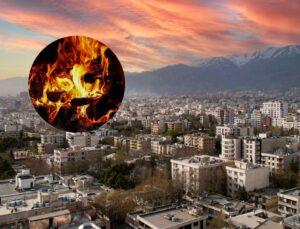




Israeli and American bombers on Saturday night launched airstrikes against numerous oil storage facilities in and around the Iranian capital city of Tehran. Videos widely shared on social media showed massive explosions and billowing smokestacks as oil storage tanks went up in flames, sending massive plumes of smoke into evening skies that glowed an orange hue, caused by a fire burning throughout the night.
SIGH! Looks like the conflict is not ending anytime soon.
These strikes are an escalation against Iran, Israel and the United States, as attacks to date have directly targeted the energy infrastructure of Iran, which has primarily been avoided previously during the initial stages of the conflict.
Here’s a basic explanation for people to get a better idea of what occurred and how that impacts them…
Explosions Rock Tehran As Oil Storage Tanks Burn
Explosions were heard late Saturday night and early Sunday in many areas throughout Tehran and neighboring areas. Reports indicate that multiple energy complexes and fuel storage depots were struck, with several large fires continuing to burn for hours following the impact.
Footage posted on social media shows multiple oil facilities with hundreds of feet of flames coming out of them, and thick smoke covering the sky over the city.
Videos captured near the highway bordering the north side of Tehran towards the suburb of Lavasan show a large oil storage facility burning with flames reaching high above any buildings or roads nearby.
One of the most damaged facilities is the Shahran oil depot, located on the northwest side of Tehran. The Shahran oil depot has been previously targeted by Israel last year and reports show a large column of black smoke shooting up into the sky from the oil depot after the most recent strike.
Another oil depot in Karaj (a city located west of Tehran) was also targeted during the strikes.
The Iranian Ministry of Petroleum confirmed the attacks and reported that emergency crews are currently working to extinguish the fires. Officials issued a statement that despite the damage to many tanks, all fuel supplies will remain stable.
Why Israel Says They Are Targeting Iran’s Energy Infrastructure
The Israeli military has stated that the fuel depots which were targeted were not solely civilian infrastructures but were part of supporting the armed forces of Iran.
“The military forces of the Iranian terror regime make direct and frequent use of these fuel tanks to operate military infrastructure,” the Israel Defense Forces (IDF) said in a statement, as reported by The Times of Israel.
Israel also described the operation that occurred as a “major strike against the military without any connection to civilians” and part of the continued effort to target those military facilities associated with the Iranian government.
In addition to the fuel depots that were attacked, Israel reported striking two of Iran’s “most important” ballistic missile sites, indicating that the operations will extend beyond energy targets to also include more significant military targets.
Netanyahu Hints More Strikes On The Way
While speaking about the continuing threat, Israeli Prime Minister Benjamin Netanyahu indicated that there will be more attacks on Iranian infrastructure as a long-term strategic goal.
He indicated that “moment of truth is drawing near for the Iranian people”, he said, adding that Israel is not attempting to divide the Iranian people but rather “trying to free Iran.”
Additionally, Netanyahu explained that the state has “structured plans with numerous surprises” for stage two of fighting. His comments lead one to believe that in the days ahead, Israel will continue to hit additional critical facilities in Iran.
Iran Will Take Revenge
Iran has already begun responding.
The IRGC (Islamic Revolution Guard Corps) recently announced that they began another round of attacks against Israel in response to Israeli strikes.
Iran’s leaders are also warning that Israel and its allies will suffer dire consequences. A senior Iranian politician, Ali Larijani, said that Iran will not surrender to the United States’ call for Iran to capitulate and will take revenge for the death of Iran’s supreme leader.
According to news reports from The New York Times, he added that Iran will continue to respond to Israeli attacks and make them “pay the price”.
Civilian Death Toll Has Increased
The general conflict has led to large amounts of civilian deaths on both sides. Iran’s UN Ambassador, Amir Saeid Iravani, states that U.S. and Israeli military strikes have killed approximately 1,332 Iranian civilians and that they have also injured thousands of people.
Meanwhile, Iranian attacks have also resulted in killing innocent civilians.
The death toll in Israel stands at 10, including six U.S. service members killed in drone attacks earlier in the first phase of this conflict.
Their remains were returned to the U.S. via an air force base in Delaware. Iran has also been involved in attacking infrastructure owned by U.S. allies in the Persian Gulf region.
One of these was an Iranian drone attack, which hit a water desalination facility in Bahrain, according to that nation’s interior ministry, creating significant concern as the Gulf states rely heavily on desalinated water for drinking purposes.
The Conflict Is Spreading Across The Region
This conflict has escalated beyond the borders of Israel and Iran and is spilling over into other parts of the region.
The Kuwait Defense Ministry claims to have seen a “wave of drones,” which resulted in damage to a fuel storage tank at Kuwait International Airport.
They also reported that two border guards were killed as a result of this violence. In Lebanon, Hezbollah (an Iranian-backed militia) has launched rockets and drones at northern Israel from their territory.
Israel responded to this by launching air strikes on Hezbollah’s stronghold in Dahiya, Beirut.
As reported by Lebanon’s Ministry of Health, at least four were killed and 10 were injured in air strikes.
Globally, the conflict will have an impact on the global economy and contribute to rising prices for oil.
The strait of Hormuz, which is a principal route for global oil transportation, remains almost entirely shut down because of the fighting.
As a result, oil prices have risen to levels similar to (some) of their highs that have occurred in the last few years.
In the U.S., the AAA motor club reported that between March and now, gasoline prices have risen almost 16%. Experts warn that with further attacks against energy infrastructure, prices will rise higher and will continue to shake up the global energy markets.