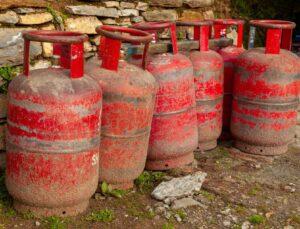




India has secured its energy future by successfully navigating one of the world’s most dangerous maritime corridors, the Strait of Hormuz, while geopolitical anxieties in the region continue to heighten between Iran, the United States, and Israel.
Indian-flagged liquefied petroleum gas (LPG) carriers are slowly making their way through this dangerous location, transporting HUGE amounts of fuel and hope for millions of people throughout India.
Both Green Asha and Green Sanvi Successfully Crossed The Strait Of Hormuz
Green Asha and Green Sanvi, both Indian-flagged LPG vessels, successfully transited the Strait of Hormuz on April 5, 2026 and April 3, 2026, respectively.
What an aura farming, sir ji!
Green Asha delivered 15,400 MT of LPG, while Green Sanvi delivered 46,650 MT of LPG with 25 crew members on board.
Each of these vessels is a part of a fleet of Indian-flagged LPG vessels that have recently been successful at transiting through this dangerous region. The total number of Indian-flagged LPG vessels that have been able to safely exit this area is now eight. Each vessel has taken a risk calculated by an array of agencies whose focus is to ensure that all vessels operating in their territory are done so safely.
However, not all vessels have been able to transit this area for safety reasons. The vessel Jag Vikram, which has no cargo aboard and is still unable to transit this region, has been unable to enter the area with 15,000 MT of LPG aboard. This reflects the degree of unpredictability that still exists in this region.
SIGH!
The Strait of Hormuz: A Key Access Point for Global Trade
The Strait of Hormuz is a vital trade route and is also the main transportation route for international oil and gas shipments. In fact, about 20% of the world’s oil passes through this channel, which makes it critical to some countries, like India, that rely almost too heavily on energy imports.
Since March 2014, following direct U.S. and Israeli airstrikes on Iran, passage through the strait has been strictly restricted. In addition to enforcing heavy restrictions on shipping traffic, Iran has created maritime restrictions to create a near-blockade of the strait that has disrupted the supply chain of oil and gas to the rest of the world.
For India, where about 90% of its liquefied petroleum gas (LPG) imports previously passed through the strait, disruption to this supply chain will result in great harm both economically and to citizens.
Response Coordination: Route Planning and Risk Management
The routes taken by vessels travelling through the strait are pre-planned and not routine or arbitrary. For example, Green Asha left Al Rams, United Arab Emirates on 30 March and in less than one hour had transited past key Iranian islands of Larak, Hormuz and Qeshm with an average speed of 12.8 knots.
These routes are selected using real-time data such as the location of land and sea obstructions, vessel size, direction, speed and any applicable weather conditions. In addition, there is real-time coordination with maritime security and intelligence services regarding the movement of vessels through transiting vessels, ensuring the timely delivery of new information to the vessels owned and operated by Indian companies.
The actions of ship owners and logistics add further complexity to this mix. MOL India owns the Green Asha, while Bharat Petroleum Corporation Ltd. charters it and has it on a route from Jawaharlal Nehru Port (Mumbai) to India. Different ownership, chartering, or routing provide evidence of the increasing difficulty of conducting worldwide energy logistics under distressed conditions.
The Bigger Picture: The Stress on India’s LPG Supply System
Because of the level of dependency upon LPG imports, the current events create even more risk for India with being the world’s second largest import user of LPG. Many millions of tonnes of LPG were consumed last year, and more than half of it was imported. And yeah, most LPG was imported from the Middle East.
This dependence on imported gas creates a situation where disruptions in the Strait of Hormuz can create a ripple effect resulting in domestic supply shortages. The Indian Government is rationing supplies to industrial users in order to ensure enough supplies for residential users.
Beyond cargo, the human aspect of this situation is as important as the tangible aspects. As of early April 2023, 17 vessels flying the Indian flag and carrying approximately 460 Indian seafarers remain in the western Persian Gulf region. So in total, there are nearly 20,000 Indian seafarers across the greater Gulf Region.
Evacuation operations are already in progress and approximately 1,479 seafarers have so far been repatriated by various shipping companies, showing a coordinated effort between the Ministry of Ports, Shipping and Waterways, the Ministry of External Affairs and Indian embassies and missions outside of India.
Gradual Recovery: More Vessels Arriving at Indian Ports
But wait, despite the current adversity, there are signs of gradual stabilisation. In recent days, multiple shipments linked to India, examples are the vessels like Pine Gas, Jag Vasant, Shivalik and Nanda Devi have successfully arrived at Indian Ports.
Additionally, a large shipment of around 47,000 Metric Tonnes of Liquid Petroleum Gas (LPG) arrived at the Vadinar terminal located in Jamnagar, Gujarat on the 28th of March; this cargo will be transferred using a Ship-to-Ship transfer operation providing for proper distribution of LPG across India.
Waiting on the Wings: Vessels Still Awaiting
While there are vessels currently arriving at ports, there also are vessels that remain anchored and waiting for safe passage. At this time, three Foreign Flagged vessels carrying approximately 87,000 Metric Tonnes of LPG remain anchored waiting for safe passage through the Strait of Hormuz; additionally there are at least two Indian Flagged vessels including Jag Vikram remaining in Limbo, similarly to the other vessels waiting for passage.
This Is Important: Energy, The Economy and Everyday Life
At the core of this matter is not just about the vessels and Sea Routing of vessels, but also about the energy security and economic stability and daily life for millions of Indian citizens.
As nearly 598,000 passengers will also be repatriated to India during the West Asian Crisis, the Indian Government is faced with two separate and distinct challenges; ensuring the safety and well-being of citizens while ensuring they have an uninterrupted supply of energy.
The successful transportation of LPG carriers such as Green Asha and Green Sanvi put into clear POV a logistical success while reminding us of the fragile balance between the Geopolitical Landscape of the World and the Resiliency of India’s economy and citizens.